

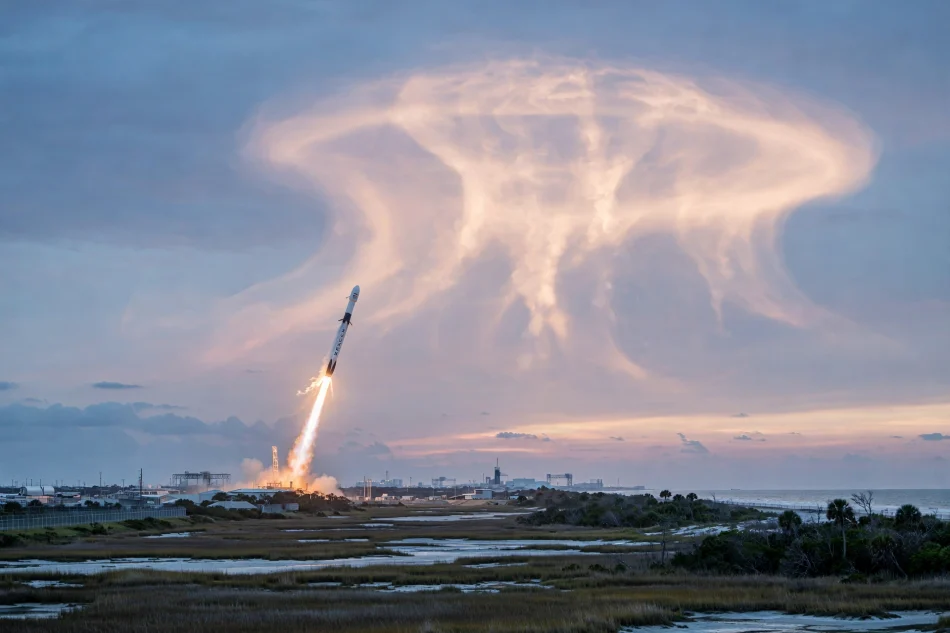
A SpaceX rocket launch at dawn produced a glowing jellyfish-shaped cloud visible across the US East Coast. Here is why the effect happens, what people saw, and how to catch the next one.
Early risers along the US East Coast were treated to an unusual sight this week when a SpaceX rocket launch lit up the dawn sky and left behind a vast, glowing shape that many described as a jellyfish drifting high above the horizon. Photos shared within minutes showed a bright core with long, translucent tendrils spreading outward, visible from hundreds of miles away even though the launch itself lasted only a few minutes.
According to reporting by The Guardian, the so-called jellyfish cloud appeared off the east coast as sunlight caught the rocket’s exhaust plume high in the atmosphere. It is one of the most striking visual side effects of modern rocketry, and it tends to happen only when launch timing, altitude and light line up almost perfectly.
Why a Rocket Exhaust Plume Looks Like a Jellyfish
The effect has a straightforward physical explanation. When a rocket climbs, its exhaust expands rapidly in the thin upper atmosphere, where there is far less air pressure to contain it. Instead of forming the tight, smoky trail seen near the ground, the plume spreads into a wide, billowing cloud. If the launch happens just before sunrise or just after sunset, the ground below is still dark while the plume, tens of kilometres up, is already catching direct sunlight.
That contrast is what makes the cloud glow so dramatically against a twilight sky. The brighter central part marks where the exhaust is densest, while the fainter streaks trailing away give the formation its jellyfish-like tentacles. Weather plays a part too: clear skies and light high-altitude winds allow the shape to hold together long enough for people across a wide region to see and photograph it.
What People on the Ground Saw
Witnesses described the cloud appearing suddenly, expanding, and then slowly fading as the sun rose higher and the exhaust dispersed. Because the formation is so high, it can be visible across several states at once, which is why social media fills quickly with near-identical photographs taken from very different places. It also explains a familiar pattern after such launches: a brief wave of confusion, with some onlookers wondering whether they have seen something unexplained.
That reaction is understandable, and it is a good reminder to pause before sharing dramatic sky footage. Our guide on how to check a viral video before you share it walks through simple ways to confirm what a clip actually shows. In this case, the explanation was prosaic but no less impressive: a scheduled launch, dawn light, and physics.
A Sign of How Routine Spaceflight Has Become
There is a bigger story behind the spectacle. Launches from Florida’s space coast have become so frequent that unusual sky phenomena linked to them are now a recurring feature of coastal life. Residents plan around launch windows, photographers set alarms for pre-dawn liftoffs, and local services increasingly treat launch traffic and viewing crowds as a normal part of the calendar.
That normalisation matters. Each flight supports communications, navigation, weather forecasting and scientific research that people rely on every day, often without thinking about the infrastructure overhead. The same system of alerts and notifications that tells residents about a launch delay is part of everyday digital life, as explained in our explainer on understanding notifications and alerts.
How to See the Next One
If you want to catch a jellyfish cloud yourself, timing is everything. Look for launches scheduled in the hour before sunrise or the hour after sunset, when the sky is dark at ground level but sunlight still reaches high altitudes. Choose a spot with a clear view toward the launch site, ideally away from city lights, and give your eyes a few minutes to adjust.
Keep expectations realistic. Not every twilight launch produces the effect: cloud cover, the rocket’s trajectory and the exact angle of the sun all have to cooperate. When they do, though, the result is unforgettable, a brief, silent reminder that some of the most beautiful sights in the sky are now made by machines built by people, doing routine work far above the clouds.