

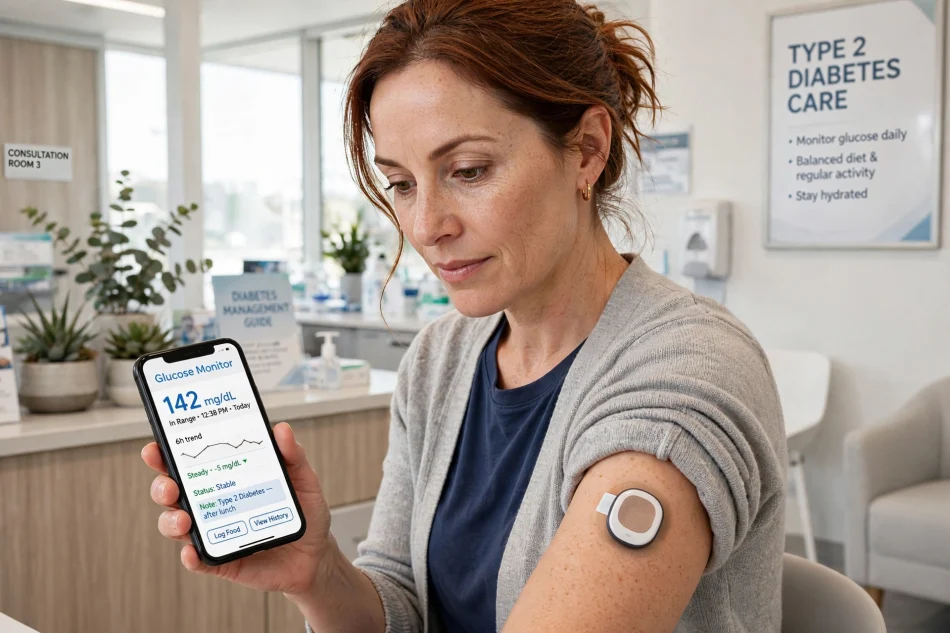
The largest trial of its kind found continuous glucose monitors helped adults with type 2 diabetes who do not use insulin spend about five more hours a day in their target blood sugar range.
Continuous glucose monitors are best known as a tool for people who use insulin, but the largest clinical trial of its kind now suggests they can make a real difference for a much wider group. Published in the New England Journal of Medicine, the study found that adults with type 2 diabetes who do not use insulin spent approximately five more hours a day in their target blood sugar range when they used a continuous glucose monitor.
Five extra hours in range, every day, is not a marginal gain. Over weeks and months, steadier blood sugar is linked with more energy, fewer sharp highs and lows, and a lower risk of the long-term complications that make type 2 diabetes such a serious condition. The findings, summarised by the University of Colorado Anschutz Medical Campus, could influence how doctors advise millions of patients who currently rely only on occasional finger-prick tests or periodic lab checks.
What the Trial Actually Tested
Continuous glucose monitors, often called CGMs, are small wearable sensors, usually worn on the arm or abdomen, that measure glucose in the fluid under the skin every few minutes. The readings are sent to a phone or receiver, showing not just a single number but a trend: whether levels are rising, falling, or holding steady, and how meals, activity, sleep and medication affect them through the day and night.
Until now, strong trial evidence in people with type 2 diabetes who are not on insulin has been limited, and access has often followed that evidence gap. By enrolling a large group and tracking time in range as a primary outcome, this trial gives clinicians a clearer answer than smaller studies could: real-time feedback changes behaviour and outcomes in measurable ways, even without insulin therapy.
Why Seeing the Data Changes Behaviour
The likely mechanism is not mysterious. A finger-prick test tells you where your blood sugar is at one moment; a CGM shows you the story around that moment. People can see a spike after a particular breakfast, notice the effect of a short walk after dinner, or spot a pattern of overnight lows that would otherwise go undetected. That immediate feedback loop turns abstract advice about diet and activity into personal, actionable information.
It also depends on alerts working well. A sensor is only useful if its notifications are clear and timely, a point we explored in our guide to understanding notifications and alerts. For CGM users, a well-timed high or low alert can prompt a small correction early, before a problem becomes more serious.
What This Means for Patients and Health Systems
For patients, the result strengthens the case for asking a doctor whether a CGM is appropriate, especially for those whose blood sugar remains hard to control with medication, diet and occasional testing alone. For health systems and insurers, the question is cost versus benefit: sensors are not cheap, but neither are the hospital visits and complications that better control may help prevent. Large, well-run trials are exactly the kind of evidence payers usually want before widening coverage.
There are caveats. A monitor is a tool, not a treatment in itself, and its benefits in the trial came alongside professional support in interpreting the data. Skin irritation, alarm fatigue and the cost of ongoing sensors remain real issues, and not everyone wants a device attached to their body around the clock. The growing market for affordable, capable phones has at least made the receiving end easier, as our look at refurbished smartphones shows: the handset needed to run a CGM app no longer has to be a flagship model.
The Bottom Line
The headline finding is simple to state and significant in practice: for adults with type 2 diabetes who do not use insulin, continuous monitoring added roughly five hours a day in the healthy range. That is time the body spends under less strain, gained not through a new drug but through better information, delivered continuously and acted on in small daily choices.
Anyone considering a monitor should discuss it with their own clinician, who can judge suitability, explain how to interpret readings, and decide whether a trial period makes sense. As the evidence base grows, CGMs look set to move from a specialist tool for insulin users toward a mainstream part of type 2 diabetes care, and this trial is a major step in that shift.
Pingback: Experienced Technicians for Refrigerator Repair Round Rock TX Problems - Hoodsite