

From Conquian parlours and family game nights to clubs and smartphone apps, trace the century-long journey of rummy — and discover what has never changed about the world’s favourite card game.
Some games belong to a casino floor or a stadium. Rummy belongs to the kitchen table. For well over a century, this deceptively simple game of sequences and sets has travelled from parlours and porches to clubhouses and, eventually, to the phone in your pocket — without ever losing the warmth that made people fall in love with it in the first place.
Where the Story Begins
Most historians trace rummy’s roots to Conquian, a Mexican game documented in the 1890s, itself possibly influenced by Chinese card and tile games that travelled across the Pacific. By the early twentieth century, variants were flourishing in the United States. Gin rummy, created in New York in 1909, became a sensation among Broadway actors and Hollywood stars, while in India a 13-card version took hold so firmly that it became a fixture of festivals, weddings and long train journeys.
What made rummy spread so far, so fast? The ingredients were irresistible: a standard deck of cards, rules a child could learn in ten minutes, and enough strategy to keep adults happily demanding rematches for decades.
The Golden Age of Family Game Night
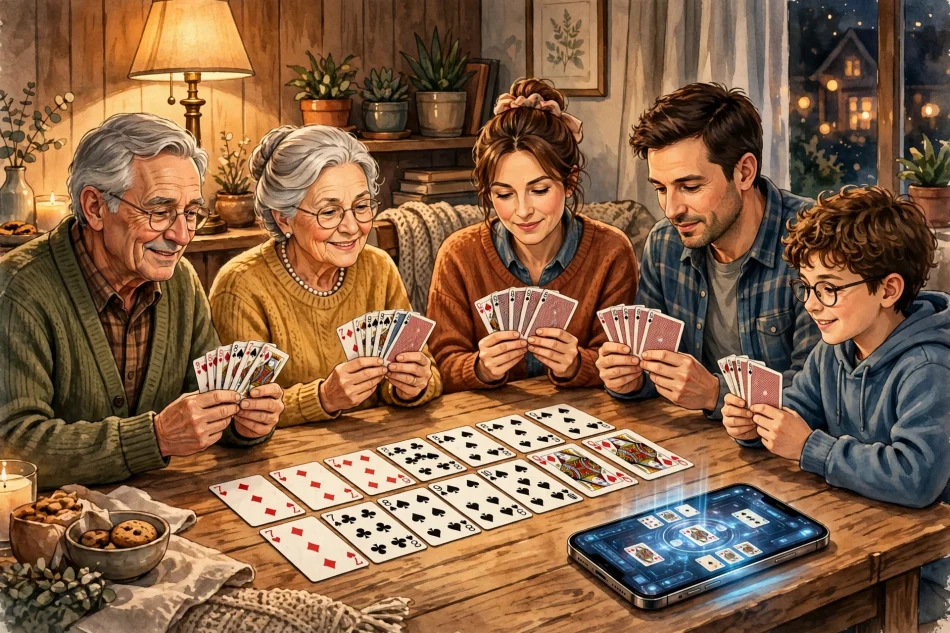
Through the middle of the twentieth century, rummy settled into its most beloved role: the family game. Grandparents taught grandchildren over holiday tables. Neighbours dropped by for an evening hand or two. In many households, a battered scorebook — recording years of wins, losses and fiercely disputed rulings — became something of a family heirloom.
The game taught more than card sense. Children learned arithmetic by counting points, patience by waiting for the right draw, and grace by losing to a smiling grandmother. Because anyone could join in, the rummy table became one of the few places where three generations could compete as genuine equals, and where the youngest player at the table could occasionally beat everyone.
Clubs, Cafés and Community Halls
Where families played at home, communities played together. Rummy clubs sprang up in towns and cities, offering regular tournaments and a ready-made social circle. In India, rummy clubs became neighbourhood institutions, and the game grew inseparable from Diwali celebrations, when playing cards with family and friends is considered auspicious. Café owners in Europe kept decks behind the counter for regulars, while cruise ships, railways and holiday resorts all discovered that a rummy table never stayed empty for long.
This club era mattered because it standardised the game. House rules gradually gave way to shared conventions — how to meld, how to score, what counts as a valid declaration — and those conventions would later make the jump to digital play remarkably smooth.
The Digital Leap
When home computers arrived, rummy came with them. Early software versions let solitary players practise against the machine, but the real revolution waited for the internet. Online tables recreated the club experience at any hour: real opponents, real pride at stake, and no need to shuffle, deal or keep score by hand. The smartphone completed the journey. Suddenly, family game night could happen between cousins in three different cities, each playing from their own sofa.
Modern platforms have polished the experience further, with quick matches, themed tournaments and tables suited to every skill level. Services such as Love Rummy show how far the format has come, bringing the classic 13-card game to phones and browsers with the social buzz of the old club nights intact.
What Hasn’t Changed
Strip away the screens and the software, and the heart of rummy is exactly where it always was. You are still watching the discard pile like a hawk. You are still one card away from a pure sequence and trying hard not to show it on your face. The joker still rescues hopeless hands, and a well-timed drop still saves you from a heavy defeat.
Perhaps that is the real secret of rummy’s longevity. Technologies change, tables change, and even families scatter across continents — but the small drama of thirteen cards, played well, never gets old. From kitchen tables to online tables, the journey continues, one hand at a time.